Optical Illusion Art Color Blue Dress Yellow Dress Explained
It's not every day that fashion and scientific discipline come together to polarise the world.
Tumblr blogger Caitlin posted a photograph of what is at present known equally #TheDress – a layered lace dress and jacket that was causing much distress amid her friends. The distress spread apace beyond social media, with Taylor Swift admitting she was "dislocated and scared".
I don't sympathise this odd dress contend and I feel like it's a pull a fast one on somehow. I'grand dislocated and scared. PS it's Apparently BLUE AND Blackness
— Taylor Swift (@taylorswift13) Feb 27, 2015
The internet is now fabricated up by people firmly in two camps: the white and golden, and the blue and blackness – with each thinking the other is completely wrong.
But Ron Chrisley, manager of the Centre for Research in Cognitive Scientific discipline at the University of Sussex, believes that the problem mainly lies in the fact that everyone has forgotten we are dealing with an illusion.
Chrisley said: "The first stride in reaching a truce in the dress war is to construct a demonstration that can show to the white-and-gold crowd how the very same dress tin can also look blue and blackness under different weather."
The image below, tweeted by @namin3485, demonstrates that fifty-fifty though the correct-manus side of each image is the same, in the context of the 2 different left halves, the right is interpreted as being either white and gold, or blueish and black.
So does this mean people who are less self-confident are more probable to be able to see both, at least eventually?
Chrisley said: "My guess is it'southward not to practise with self-confidence. Information technology's a perceptual result. I could imagine someone that'due south open minded could still see it only one fashion. This is below the level of united states of america trying to empathise other peoples views. Information technology's more physiological than that."
Look at the image below. The colour of surfaces A and B are identical. Place your finger over the join where the superlative and bottom half of the image run across.
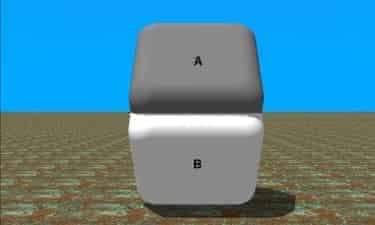
Both surfaces are grayness, correct? But how?! Why?!
Chrisley said: "Which colour we run across isn't just a matter of the light coming into optics, it'southward the inferences that caused that input. We utilize the context to inform our colour experiences.
"Some suffer more than others due to how people factor in context in order to construct a colour experience. Some people see just what's in front of them and some people are affected much more than by the context.
"This has yet to be proven, only given what we know of the brain, and it's a good guess, is that someone who is used to manipulating images and white remainder might be able to perceive the true dress colour in a wider range of contexts and ignore context, whereas others tin be hands manipulated. People who have changed luminance in Photoshop may not be fooled by information technology."
Have the post-obit colour illusion. Squares A, B and C appear to be different shades of dark-brown. Cover the surrounding squares and you'll run across they are in fact the same colour.
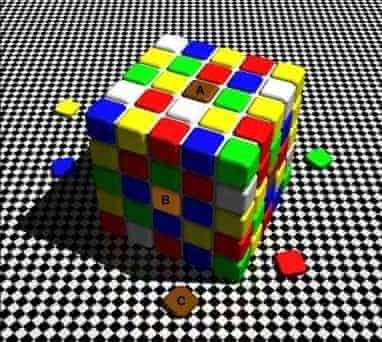
Chrisley said: "Another striking thing about the wearing apparel illusion is that it is quite unlike the checked shadow illusion, in that not all people feel it, and those that exercise ofttimes exercise and then differently.
"It is equally if there is a perceptual equivalent of those who can roll their tongues and those who can't. Only information technology is too early to say whether the difference is genetic, as with tongue rolling power, or something affected by learning and personality such every bit existence a night-owl or 1's particular sensitivity to context in perception, every bit I and boyfriend Sackler colleague Acer Chang speculate."
Here's the scientific discipline behind #TheDress colour illusion
You may accept gathered this by at present, but what we are experiencing is really a color illusion. Colour illusions are images where the object's surrounding colours play tricks the middle into incorrectly interpreting the colour.
What'southward happening with #TheDress is that your eye is either discounting the blue so you're seeing white and gilded, or discounting the gold so your eye sees bluish and blackness. But why would your optics lie to you similar this?
Human beings evolved to see in daylight, but daylight changes the color of everything we see. Human eyes try to compensate for the chromatic bias of daylight colour.
Nosotros meet objects because light is reflected. When nosotros await at something, low-cal enters the eye with unlike wavelengths which correspond to different colours. This light hits the retina in the dorsum of the center where pigments shoot signals to the function of the brain that processes these signals into an image.
Your brain figures out what color light is bouncing off the object your optics are looking at by subtracting that color from the existent colour of the object.
Speaking to Wired mag, Bevil Conway, a neuroscientist who studies colour and vision at Wellesley Higher in Massachusetts said: "Most people will see the bluish on the white background as blue. Merely on the black groundwork, some might run into it as white."
fullartonobtionve.blogspot.com
Source: https://www.theguardian.com/technology/blog/2015/feb/27/science-thedress-colour-illusion-the-dress-blue-black-gold-white
0 Response to "Optical Illusion Art Color Blue Dress Yellow Dress Explained"
Post a Comment